Creek Line Plumbing
A plumber who works at customers' homes, with no public address.
Open the plumber demo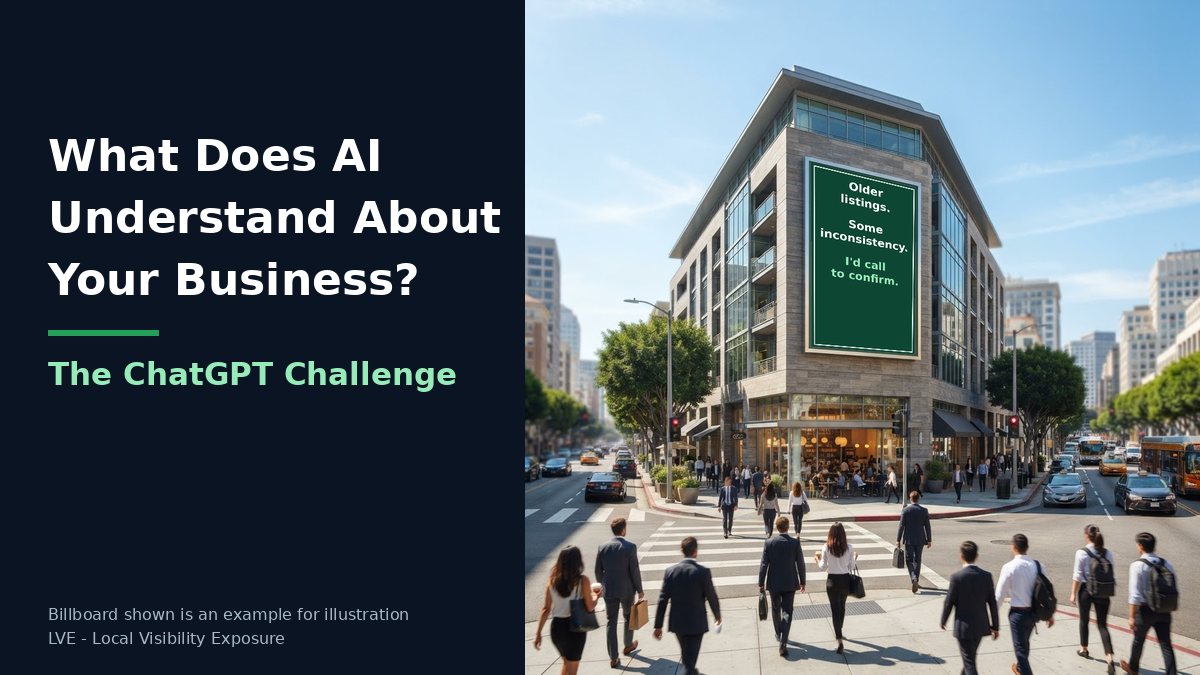
Most local business owners have a clear picture of what Google says about them. They've seen their listing, checked their reviews and looked at their map pin.
Almost none can say what ChatGPT says about them. That's the part most owners haven't thought about, because they treat AI as a faster Google. It works differently, and the difference is what this challenge shows.
BrightLocal surveyed 1,002 U.S. adults for its Local Consumer Review Survey 2026. 45% said they had asked a generative AI tool for a local business recommendation. A year earlier, that was 6%.[1]
Owners don't see this in a report they check, so it's easy to miss.
Google shows a list, and you can see where you sit on it. ChatGPT gives one answer in a sentence or two, and the customer moves on. There's no page two.
Your website is one source of several. BrightLocal's 2026 study of 1.9 million citations from Google's AI results and ChatGPT found the assistants drawing heavily on third-party sites such as Yelp and other directories.[2] AI often pieces a business together from directories, booking pages and other third-party sites, instead of one trusted source: yours.
Different assistants can give different answers about the same business, and the same assistant can answer differently on another day. One check shows you one picture.
In the same survey, 40% of consumers said they trust AI platforms for business recommendations and 32% said they don't.[1] So people are using it and checking it at the same time. A business that's described clearly holds up. One that's described vaguely gets passed over.
On October 13, 2026, I ran the challenge on a local chiropractic clinic with a detailed website. I asked ChatGPT and Perplexity the same question: what services do they offer, what are their hours, and how do customers book?
ChatGPT got the hours right. Perplexity gave hours from a third-party listing that didn't match the clinic's own website or its Google Maps listing. Its review count was also out of date.
Same business, same question, two different pictures. The owner would never know unless someone asked.
A search engine looks things up. An AI assistant puts an answer together. It builds that answer about who you are, what you offer and where you do it from whatever it can find. The question isn't "do I show up?" It's "what picture does it put together, and does it match the business I run?"
That's what Local Visibility Exposure measures. Local Visibility Exposure is how easily customers, Google and AI assistants can find a local business, understand the services it offers in the areas it serves, and see the trust signals that make it worth calling.
Want to know how your Google Business Profile and website look to AI?
When an assistant decides whether to recommend a business, it's working through four questions. Who are they? What do they do? Where do they work? Why should anyone trust them?
If the answers are scattered across directories and old listings, the assistant has to piece them together, and that's where the guessing starts. If the answers are spelled out clearly in one place, there's much less to guess.
When an assistant can't tell what a business does or where it works, it doesn't stop and ask. It names a business it understands better. For the owner, that usually means a customer who was ready to call never learns the business exists.
Nothing looks broken from the inside. The phone just rings less often than it could, and the calls that go elsewhere are usually the ones from people who already know what they need.
It's common. Your free LVE report may show that your website could use some adjustment. We understand that a project like this takes time and costs money, and that can be hard on a small business.
That's why we're introducing a beta project for local businesses with:
The goal is a website that builds trust AI assistants can recognize. The project is in beta, so we're building it with the first businesses that join.
Google Business Profiles have around 4,000 categories,[3] so we haven't built a site for every kind of business. We created five live samples to give you a glimpse of what a site could look like for your company. Each one is a finished site, not a mockup. These are samples of the finished sites, so use them to see the look and feel. The ChatGPT Challenge is for your own business.
A plumber who works at customers' homes, with no public address.
Open the plumber demoA mobile dog groomer who works from a van.
Open the groomer demoA storefront near BART, with licenses, awards and a BBB rating.
Open the chiropractor demoAn office near BART, with bar credentials and multilingual service.
Open the attorney demoA second-floor hair studio with a service menu, stylist profiles and state licenses.
Open the salon demoAll five demos are fictional businesses made to show the design and structure. Your site would use only facts about your business that we can verify.
If you like what you see, each sample has a button to join the waitlist.

Certified by BrightLocal Academy in essential Google Business Profile diagnostics — the same fundamentals behind every Local Visibility Exposure report.
Credential ID 662a765d22f36be62b0c3dd1